


(English)

The AI Revolution and the Next Leap Forward in the Pharmaceutical Industry
Chime Vision | Issue 7
- AI in the Historical Context of Productivity Revolutions: AI is evolving from an information technology into a new tool of production, with the potential to drive the next major leap in productivity following the steam, electrification, and information revolutions.
- From Research to Manufacturing, AI Is Reshaping the Pharmaceutical Industry: Drug research, development, and manufacturing face distinct constraints in information processing, decision quality, and validation costs. AI offers new opportunities to improve efficiency and reduce costs across the value chain.
- From Information to Decisions, Redefining the Industry's Efficiency Frontier: As AI significantly reduces trial-and-error costs in drug research and development, manufacturing will account for a rapidly growing share of total drug lifecycle costs. Previously receiving less attention for efficiency optimization due to its relatively low cost share, manufacturing is poised to become a new frontier for AI adoption and productivity gains.
- From AI Enablement to Intelligent Manufacturing, Chime Biologics Advances Its Strategic Vision: Through the Chime AI Platform and its planned Megafactory, Chime Biologics aims to integrate process development, large-scale manufacturing, data accumulation, and AI to pioneer a new model for intelligent biologics manufacturing.
I. Understanding AI’s Place in History Through the Lens of Revolutions in Productive Forces
From the perspective of historical materialism, the development of human history follows objective patterns, with the continuous advancement of productive forces serving as its fundamental driving force and ultimate determinant. To meet basic needs such as food, clothing, housing, and transportation, human beings must continually engage in the production of material goods. Admittedly, humanity has also created countless treasures in the realms of intellectual and cultural production, including the humanities, art, philosophy, and religion, enriching our spiritual lives. Yet these forms of production are built upon a material foundation and, as productive forces advance and relations of production evolve, are reflected in the development of human thought, ideology, and the superstructure of society.
Throughout most of human history, the development of productive forces was slow. It was not until the Age of Exploration, with the accelerating movement of resources, populations, and knowledge across the world, together with the resulting transformation of relations of production, that growing numbers of people were freed from direct material production to pursue research in the natural sciences. This, in turn, helped lay the foundations for the Scientific Revolution. As global markets subsequently expanded and competition intensified, the demand for greater production efficiency and expanded reproduction became increasingly pressing, accelerating the transformation of scientific discoveries into industrial technologies. As these technologies continued to develop and accumulate, the Industrial Revolution emerged.
From that point onward, the primary driver of productivity growth gradually shifted away from traditional inputs such as land, natural resources, and labor toward science and technology. By pushing beyond the resource constraints imposed by traditional factors of production, science and technology opened up new possibilities for productivity growth, ultimately becoming the primary productive force.
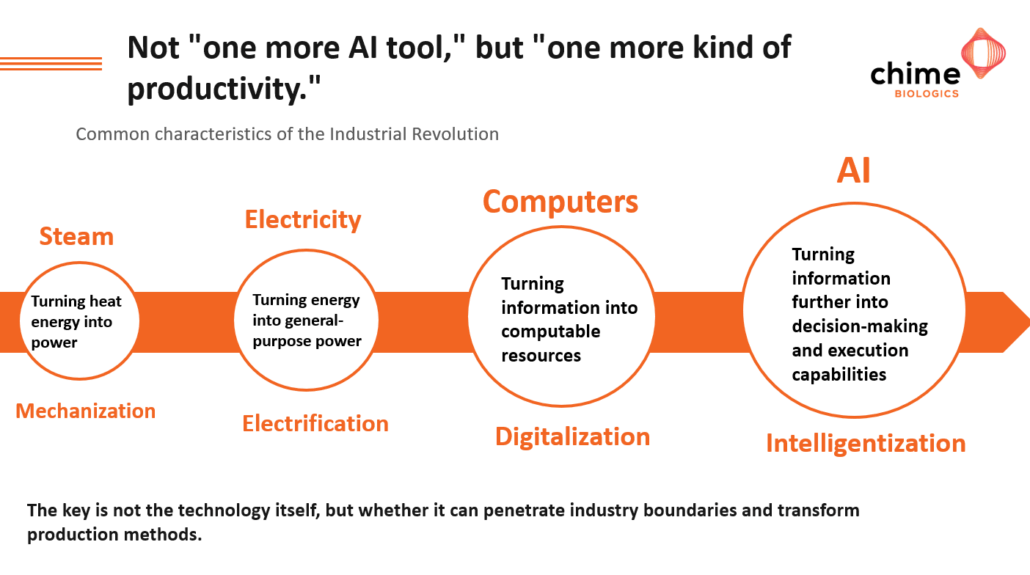
Each industrial revolution driven by technological progress deserves the name revolution because the enormous leap in productive forces it generates is not confined to any single industry. Rather, it empowers industries across the board and fundamentally transforms the way society produces goods and services. The First Industrial Revolution, represented by the steam engine, converted the thermal energy of coal into powerful mechanical energy, moving humanity from an agricultural and handicraft-based society toward large factories and mechanized, socialized mass production. The Second Industrial Revolution brought the widespread application of electricity. Electric motors, internal combustion engines, and communications technologies transformed power generation, transportation, manufacturing, and everyday life. The Third Industrial Revolution, marked by integrated circuits and computers, dramatically expanded humanity's capacity to store, process, and transmit information, ushering in the Information Age.
Today, however, the explosion of information has created new bottlenecks: human attention, information-processing bandwidth, and the brain's capacity to process information. Generative artificial intelligence has emerged to help shoulder the burden of acquiring, processing, and producing information. As AI agents become increasingly capable of reasoning, demand is growing rapidly for them to execute tasks and validate outcomes in the physical world. This is driving rapid advances in embodied intelligence, robotics, and robots operating across different modalities.
If computers and the internet dramatically expanded humanity's ability to access, store, and transmit information, AI is now extending our capacity to process information, make decisions, and execute complex tasks. In doing so, AI is evolving from an information technology into a new tool of production.
II. From Research to Manufacturing: How AI Will Reshape the Pharmaceutical Industry
Against this historical backdrop, examining the pharmaceutical industry brings the potential significance of AI into sharper focus. Broadly speaking, the industry comprises three stages: drug research, drug development, and drug manufacturing.
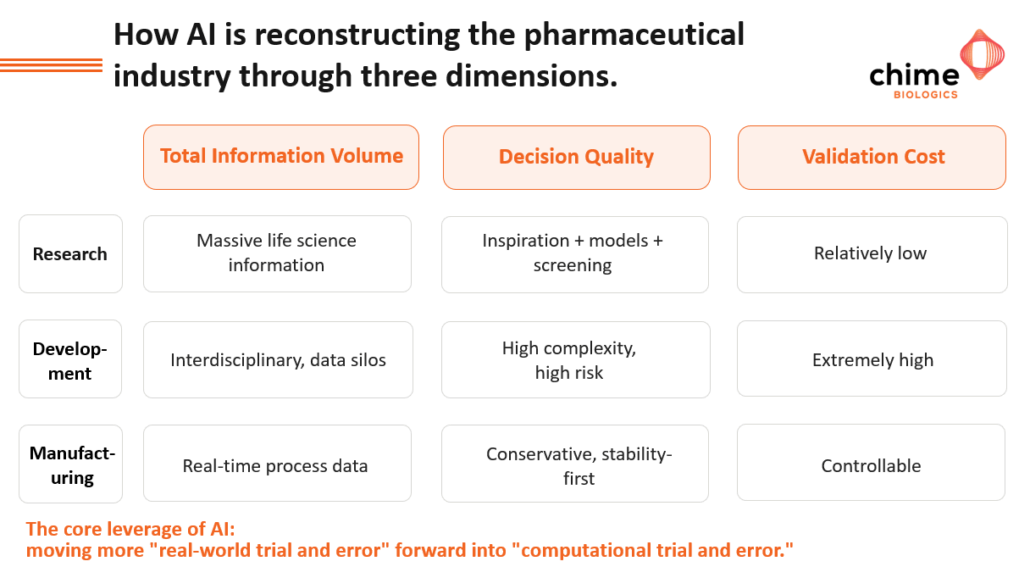
To better illustrate how technological revolutions can drive the industry's development, we will examine these three stages through the lens of the Information Age and emerging AI technologies, focusing on three dimensions: information volume, decision quality, and the cost of validation. Each stage has distinct characteristics and faces different constraints, with correspondingly different opportunities for transformation through the continued application of AI.
The core challenge in the research stage is to identify new targets, mechanisms, and candidate molecules from vast amounts of information, while working within the limits of our understanding of biology. The greatest constraint is often the boundary of human knowledge regarding complex biological phenomena. However, validation typically involves small-scale mechanistic experiments and high-throughput screening at small reaction volumes, making it relatively inexpensive. As a result, decisions can to some extent rely on intuition, inspiration, and serendipity.
The development stage starts with a relatively well-defined candidate and focuses on determining how to validate and optimize it, ultimately transforming it into a drug that can be approved and manufactured. This stage must integrate vast amounts of experimental, process, clinical, and regulatory information. Because it spans multiple disciplines, including pharmaceutics, toxicology, medicine, and bioprocess engineering, the information involved is complex and often fragmented across data silos. Meanwhile, real-world validation is extremely expensive, placing exceptionally high demands on decision quality.
The manufacturing stage, by contrast, begins with an established product and process. By continuously processing large volumes of production data and process variables, manufacturers seek to optimize quality, efficiency, cost, and consistency. Decision-making tends to be more conservative. Yet validation costs are manageable, while the potential savings in manufacturing costs over a drug's entire lifecycle can be substantial. This creates considerable scope for further optimization and improvement.
III. From Information to Decisions: The Efficiency Frontier of the Pharmaceutical Industry Is Being Redefined
In summary, research seeks to answer, “Can we find the right candidate?” Development asks, “Can we successfully turn it into a drug?” Manufacturing addresses the question, “Can we produce the drug consistently, efficiently, and at low cost?”
Across all three stages, the greater the volume of information processed and the higher the quality of decisions, the greater the likelihood of successful validation in the real world, and the lower the resulting costs. Advances in information technology and AI will drive exponential increases in both the volume of information that can be processed and the quality of decisions. Meanwhile, the costs borne by pharmaceutical companies, whether in electricity and computing resources or in fees paid to AI technology providers, may be several times lower than the costs saved through higher real-world validation success rates.
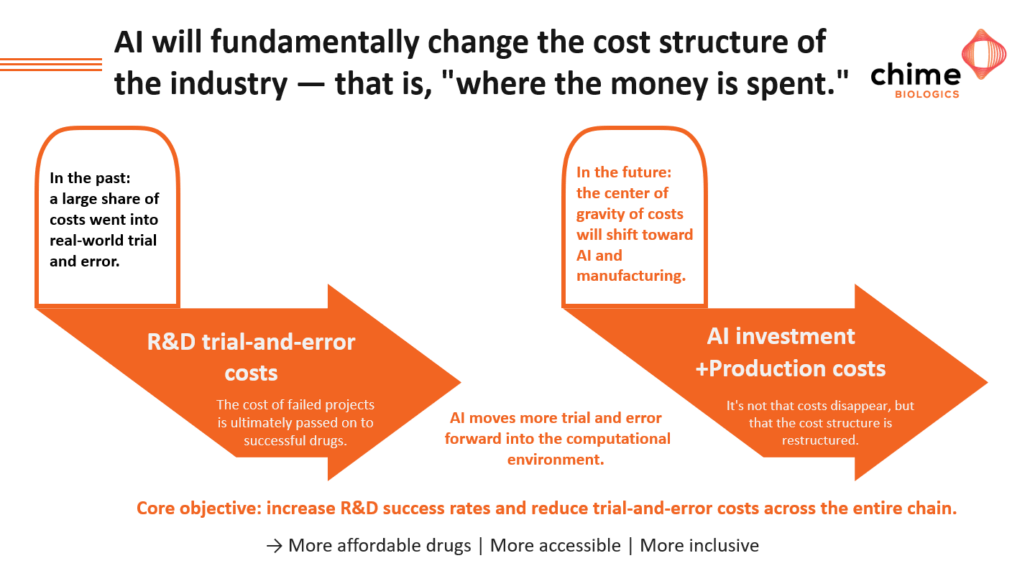
As this transformation unfolds, the major cost components of medicines are likely to shift. Instead of being dominated by the substantial costs of trial and error in research and development, drug costs will increasingly reflect pharmaceutical companies' own investments in AI, service fees charged by companies providing AI-powered drug development technologies, and the costs of drug manufacturing itself.
Fundamentally, AI will significantly reduce the costs of trial and error across drug research, drug development, and manufacturing. This is particularly important for the development stage, which accounts for a substantial share of total costs. By doing so, AI will dramatically improve efficiency across the entire pharmaceutical value chain.
Just as the steam-powered revolution ushered in a period of extraordinary growth in coal, steel, and machinery, and the electrification revolution drove the expansion of electrical equipment and household appliances, the Information Revolution fueled the growth of computers and communications equipment. Similarly, the widespread application of AI throughout the pharmaceutical industry will usher in a sustained boom in drug discovery, development, and commercialization.
For each of us, the most tangible consequence of this tremendous efficiency gain will be the continued and rapid improvement of drug affordability, accessibility, and equitable access to medicines.
Returning to the central argument at the beginning of this article, the history of human society is a history of the development of productive forces and, ultimately, of material production. Whether driven by immediate practical needs or more ambitious aspirations, humanity continually explores the unknown, deepens its understanding of nature, and transforms the natural world through productive labor.
Compared with other material production industries, pharmaceuticals have one defining characteristic: their direct object of action is the human body. Medicines improve physiological conditions and meet people's fundamental needs for health and longevity. These needs are more compelling and enduring than those associated with many other efforts to transform the natural world.
Although life sciences have achieved numerous breakthroughs in recent decades, our fundamental understanding of biological phenomena remains relatively limited, and progress has been comparatively slow.
Consider the contrast with the Information Revolution. Under the trajectory described by Moore's Law, the number of transistors on a chip doubled approximately every 18 months. Enabled by this technological progress, the processing speed, transmission rates, storage capacity, screen resolution, and camera pixel counts of personal electronic devices such as computers and smartphones advanced rapidly. In less than a generation, these capabilities grew exponentially, increasing by several orders of magnitude.
By contrast, in the field of human health, setting aside external factors such as acute fatal diseases, famine, and war, the natural human lifespan may have increased by only about twofold over thousands of years or longer, even before accounting for the gains in longevity attributable to modern improvements in food availability, public health, and other factors.
This contrast highlights the enormous untapped potential for productivity growth in human health. One major constraint is that biological systems are far more complex than conventional engineered systems, while humanity's understanding of life remains limited.
The AI revolution now offers an opportunity to overcome these longstanding bottlenecks.
During the Information Age, bioinformatics emerged as an interdisciplinary field that brought the power of information technology to biology. It enabled the storage and analysis of sequence information for biological macromolecules such as DNA, RNA, and proteins, as well as the analysis of genotype-phenotype relationships.
In today's AI era, technology has the potential to go further, empowering the entire pharmaceutical value chain and continuously improving efficiency and reducing costs across research, development, and manufacturing.
In other words, bioinformatics gave humanity the ability to process vast amounts of life sciences data for the first time. AI is taking the next step, enabling machines to participate in understanding, reasoning about, predicting, and making decisions based on complex biological information. The pharmaceutical industry, whose progress has traditionally been constrained by the limits of human cognition and information-processing capacity, now has the opportunity to harness an entirely new set of productive tools.
IV. From AI Enablement to Intelligent Manufacturing: Chime Biologics' Strategic Choice
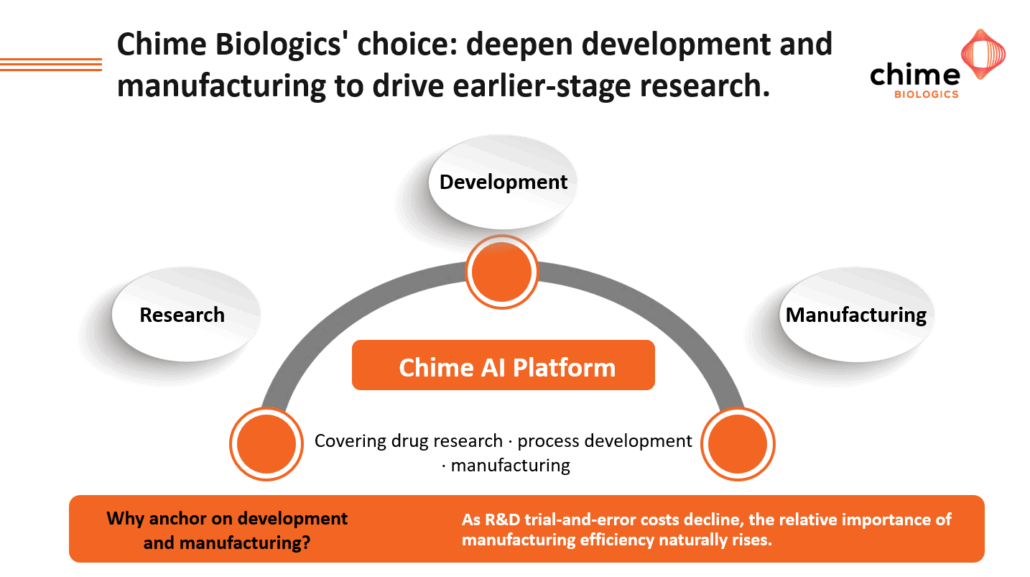
Against this backdrop, Chime Biologics has remained focused on biopharmaceutical development and manufacturing, using these strengths to drive innovation further upstream into early-stage research. To this end, we have launched the Chime AI Platform, spanning drug research, process development, and manufacturing.
This major strategic initiative is grounded in a central insight: because traditional pharmaceutical development has been constrained by our limited understanding of biology, enormous resources have been consumed in validation activities such as animal studies and large-scale clinical trials. The substantial risks inherent in drug development have also meant that the costs of failed programs are, to a large extent, ultimately borne by the drugs that successfully reach the market. This makes new medicines less affordable and accessible, preventing the benefits of pharmaceutical innovation from reaching a broader population.
As AI becomes deeply integrated into drug research and development, the costs of validation across both stages will fall rapidly. Increasingly, approaches that previously had to be screened through real-world experiments, animal studies, and clinical trials can be predicted and compared in advance in computational environments.
At the same time, process development and manufacturing will account for a correspondingly larger share of total costs. This will direct more resources toward improving efficiency and reducing costs in manufacturing, where AI will naturally play a significant role.
In other words, as AI progressively reduces the costs of trial and error in research and development, manufacturing efficiency itself will become increasingly important. Competition in the pharmaceutical industry will extend beyond discovering and developing a drug to encompass how to manufacture it consistently, efficiently, and cost-effectively.
Historically, the costs of trial and error in drug development have represented an extremely significant component of the pharmaceutical industry's overall cost structure. As AI continues to reduce validation costs in research and development, the importance of manufacturing efficiency across the entire value chain will naturally rise.
In response to this transformation, Chime Biologics will soon begin construction of its Megafactory in Wuhan Optics Valley, Hubei Province, China. Designed to feature one of the world's largest numbers of production lines and the largest single-facility production capacity in China, the Megafactory will fully embrace AI. It will leverage China's comprehensive industrial ecosystem and efficient energy supply, while serving the diverse needs of the world's largest pharmaceutical consumption market.
By applying AI across a broad range of real-world industrial operations, we aim to build and operate a world-leading intelligent facility for biologics process development and manufacturing.
The concept of a Megafactory means far more than simply having more production lines or greater capacity. It represents the deep integration of process development, manufacturing, data accumulation, and AI technologies. The combined scale advantages of process development and manufacturing, reinforced by AI, will generate stronger efficiency gains and create a mutually reinforcing cycle in which scale, data, and AI continually strengthen one another.
Through this strategy, Chime Biologics aims to take a leading role in process development and manufacturing, the critical leverage points of the evolving pharmaceutical industry. We will generate positive externalities that enhance the global competitiveness of drug developers and technology service providers, while advancing the broader industrial ecosystem through the Chime Innovation Alliance. By bringing together upstream suppliers of high-value-added products and services, we aim to serve as a leading enterprise anchoring the biopharmaceutical value chain, working alongside our partners to drive the continued transformation, upgrading, and high-quality development of China's pharmaceutical industry.
China possesses a comprehensive manufacturing ecosystem, enormous market demand, and a wealth of real-world industrial experience. As these advantages converge with the AI revolution, China's pharmaceutical industry has an opportunity to break through the constraints of traditional development models and achieve international leadership, just as other sectors of Chinese industry have done.
The next leap in pharmaceutical productivity is taking shape. Chime Biologics is committed to helping turn that potential into reality, advancing intelligent biomanufacturing and making the benefits of pharmaceutical innovation more accessible to people around the world.
About Chime Biologics
Chime Biologics is a leading global CDMO, focused on ensuring our customers' success in delivering innovative biologics as well as biosimilars to patients across the world. Chime Biologics can support customers end to end, from pre-clinical support and cell line development through to clinical and commercial manufacturing of drug substance and drug product. Employing our state-of-the-art capabilities in our Europe Innovation Hub (Basel, CH), China Innovation Hub (Shanghai, CN), Development & Manufacturing Campus (Wuhan, CN) and proven success in supporting our clients with their clinical and commercial authorizations across the globe, Chime Biologics is a true end-to-end solution provider for the biologics industry. With over 600 skilled employees, we share a common goal to make cutting-edge biologics affordable and accessible to patients worldwide, fulfilling our commitment to improving human health globally.
