


Interview with Peter Pang: Where Biosimilar CMC Risk Really Sits Today
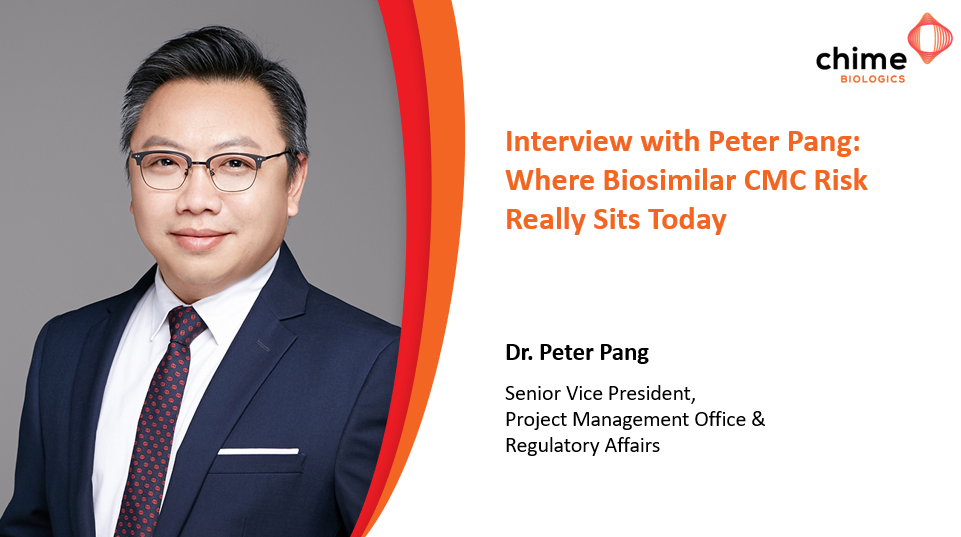
Peter, in our previous interview discussing the state on the biosimilars market, Frederic Bouvier emphasized it was on the verge of acceleration in the wake of main regulatory bodies pivoting views on the need for CES. With CES waivers becoming the new norm in biosimilar development, how has the burden shifted within the CMC package?
The burden has shifted decisively onto analytical and functional characterization. The central objective is to demonstrate that there are no residual uncertainties that would justify a comparative efficacy study. That means the comparative analytical assessment must be built on relevant, orthogonal and highly sensitive methods. Any weakness in the analytical similarity argument quickly becomes a regulatory risk.
In that context, where do you see the highest residual risk today in biosimilar CMC: structural characterization, critical quality attribute (CQA) matching or process-related variability?
The highest residual risk today is clearly process-related variability, followed closely by the complexity of structural characterization.
For process-related variability, the main uncertainties are still scale-up, raw material variability and maintaining a robust control strategy over the full lifecycle of the biosimilar. These factors remain difficult to fully de-risk early on.
On the analytical side, the issue is no longer the availability of tools. With today’s advanced analytical technologies, we can generate enormous amounts of data. The challenge is the definitive interpretation of complex datasets and translating that into a clear, defensible similarity argument.
CQA matching remains the foundation of biosimilar development. The risk here is less technical and more strategic. How CQAs are tiered, how acceptance criteria are set and whether there is a deep enough understanding of the molecule to justify those decisions.
How early should sponsors lock in their manufacturing process to ensure comparability without constraining later scale-up or site transfers?
Much earlier than many sponsors would think.
With today’s reduced clinical programs, skipping CES and relying on a single PK or PK/PD study, the process really needs to be locked before IND or CTA submission. At that point, the process should already be at (or representative of) commercial scale, and the material used in the PK or PK/PD study should demonstrate sufficient analytical similarity to the reference product.
This approach allows late-stage CMC activities, such as process characterization and process validation, to run in parallel with clinical development. The result is a significantly compressed overall timeline for your biosimilar.
How do regulators assess manufacturing changes after the comparability exercise, especially when process optimization continues late in development?
For biosimilars, the goal is to demonstrate high analytical similarity to the reference biological product and to support this with one pivotal comparative PK or PK/PD study. Ideally, there should be no Phase 1 or early clinical supply manufactured under a provisional process.
That means the process should already be well developed and largely optimized before IND or CTA. Significant post-comparability changes introduce regulatory complexity and risk that can usually be avoided with stronger upfront process development.
From your experience, which upstream parameters have the greatest impact on glycosylation and other clinically relevant CQAs? And how tightly do they need to be controlled?
Control should always be risk-based and the required level of control depends on how strongly a given attribute impacts potency and safety. Parameters that directly influence glycosylation patterns, charge variants or other clinically relevant CQAs need tighter control than those with minimal clinical impact.
The key is understanding both the process variability and the clinical relevance of each attribute, as well as aligning the control strategy accordingly.
Downstream processing is often treated as a standard platform. Where does that assumption break down in biosimilar development?
Platform thinking works, up to a point.
A well-designed downstream process must achieve three things simultaneously:
- Maintain high yield to keep cost of goods under control
- Minimize processing time, which directly impacts manufacturing utilization (and thus the price)
- Reliably meet regulatory expectations for impurity removal
Where the platform assumption breaks down is when molecule-specific impurities, yield losses, or time constraints are underestimated. At that point, downstream processing becomes a strategic lever, not just a technical one.
For sponsors outsourcing biosimilar manufacturing, which CMC capabilities should be non-negotiable when selecting a CDMO?
Three things are essential.
First, deep process development expertise. Not just execution, but real understanding of how to match CQAs to the reference product.
Second, a comprehensive analytical capability. This goes far beyond owning the right instruments. The CDMO must be able to interpret complex analytical datasets and translate them into clear regulatory arguments.
Third, a robust, high-titer, high-yield process, supported by a cost-effective and reliable supply chain. Without this, commercial viability is at risk regardless of technical success.
As portfolios expand and timelines compress, do you see biosimilar CMC moving toward a more platform based, high-throughput model? And where are the regulatory limits?
Every biosimilar is still unique and that won’t change.
That being said, speed comes from discipline. The keys to accelerating biosimilar CMC are what we internally refer to as “Chime’s four Cs”: Compliance, Competence, Capacity and Cost.
High-throughput approaches, particularly in cell line development, are extremely valuable. Rapidly identifying the right clone with high productivity is often the first critical success factor. Beyond that, your platform must remain flexible enough to accommodate molecule-specific risks and regulatory expectations.
Peter, thank you for the clear and practical insights. As clinical requirements shrink, the real risk has shifted to analytical strength, early process lock-in and disciplined control of variability. In this environment, sponsors not only need a solid strategy but an experienced partner with the technical depth and regulatory understanding to execute it right from the start.
About Chime Biologics
Chime Biologics is a leading global CDMO, focused on ensuring our customers' success in delivering innovative biologics as well as biosimilars to patients across the world. Chime Biologics can support customers end to end, from pre-clinical support and cell line development through to clinical and commercial manufacturing of drug substance and drug product. Employing our state-of-the-art capabilities in our Europe Innovation Hub (Basel, CH), China Innovation Hub (Shanghai, CN), Development & Manufacturing Campus (Wuhan, CN) and proven success in supporting our clients with their clinical and commercial authorizations across the globe, Chime Biologics is a true end-to-end solution provider for the biologics industry. With over 600 skilled employees, we share a common goal to make cutting-edge biologics affordable and accessible to patients worldwide, fulfilling our commitment to improving human health globally.
For more information, please visit www.chimebiologics.com.

