

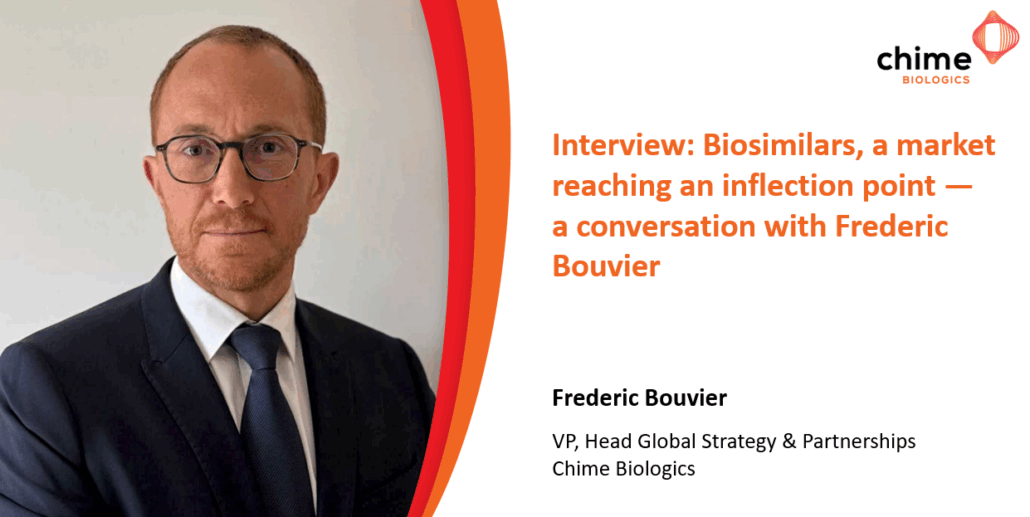
Interview: Biosimilars, a market reaching an inflection point - a conversation with Frederic Bouvier
Frederic, everyone talks about biosimilars as a maturing market. How do you see it?
I actually think the word “maturing” misses the point. Biosimilars are not maturing, they’re just getting started.
If you rewind, the journey began almost 20 years ago. Europe led in the mid-2000s, the US followed a decade later. That phase was about building trust, science and regulatory foundations.
Now we’ve reached scale with more than 90 biosimilars approved in Europe and 60 in the US, covering over 20 originator products. Although not all numbers are out yet, global biosimilar sales are expected to exceed EUR 30 billion in 2025.
But the real story is what comes next. Projections point to a six-fold expansion by 2035, reaching about EUR 180 billion.
That’s not a market reaching maturity, that’s a market entering an acceleration phase, where biosimilars shift from being an option to becoming the baseline of care.
What are the drivers of this trend?
Several forces are converging.
First, confidence has finally caught up with the science. Prescribers now have years of real-world experience and the debate around efficacy and safety is largely behind us.
Second, economics are becoming unavoidable. Healthcare systems are under immense cost pressure and biosimilars offer one of the few proven levers to bend the biologics cost curve. As a result, their use is increasingly incentivized and, in some cases, actively steered.
Third, we’re approaching an unprecedented patent cliff. Over 100 biologics are set to lose exclusivity in the coming years, including multiple megabrands with annual sales exceeding EUR 10 billion.
And finally, regulation is catching up with reality. Clinical efficacy study (CES) waivers are becoming the norm, significantly lowering barriers to entry and accelerating timelines.
Let’s focus on the CES waiver. Why is this shift so transformative?
Because it removes what was, in many cases, an artificial barrier to competition.
For years, developing a biosimilar meant running long and costly CES, long, expensive Phase 3 trials against the originator. In some therapeutic areas, like rare diseases, this requirement often made biosimilar development structurally impossible.
Yet the evidence tells a different story: when analytical and Phase 1 clinical data are robust, biosimilars consistently perform as expected. In fact, no biosimilar with positive analytical and Phase 1 results has ever failed a CES, and none has revealed meaningful safety or efficacy issues in real-world use.
These studies were adding years and tens of millions in cost without adding real insight, stretching programs to eight or nine years and €150–200 million.
Because of that, industry experts and key opinion leaders pushed for change, and regulators eventually caught up with science. The UK MHRA led the way, with the EMA and FDA following, and most recently regulators such as the Saudi FDA have clarified that CES will not be required by default when analytical and PK/PD data sufficiently address remaining uncertainties.
The result is simple: timelines shorten by two to three years and development costs are cut roughly in half.
That fundamentally changes who can compete, what can be developed and how quickly biosimilars can reach patients, right?
Exactly. The playing field is being reshuffled along two dimensions: who can enter and what gets developed.
Historically, biosimilars were the domain of large biopharma. They were the only players with the capital, scale and capabilities to absorb complexity and risk. It was, quite literally, a rich man’s sport.
That’s no longer the case.
With lower barriers, small and mid-sized pharma and generics companies, can now participate. Even regional players, whether from LatAm, Middle East & Africa, or Asia-Pacific, can “afford” biosimilars. The door has opened and competition is broadening.
Target selection is changing just as dramatically. The old economics forced developers to chase €3–4 billion biologic blockbusters.
As a result, 80% to 90% of biologics were left without biosimilar competition (the so-called biosimilar void) and many patients left without affordable alternatives.
With shorter timelines and lower costs, the viable threshold drops to around €2 billion or even below. That materially expands the opportunity set, starts to close that biosimilar gap and brings competition to large parts of the biologics market that were previously untouched.
As you stressed, with lower barriers comes more competition. How to win in this new biosimilar paradigm?
That’s the right question.
As barriers fall and competition increases, prices will erode faster and product lifecycles will compress. Some players will exit because the economics no longer meet their expectations. Others will adapt. And new entrants will come in because the market now looks accessible.
There’s a lot of discussion about end-to-end vertical integration as the answer. It may work for a few companies, but I don’t believe it’s a universal solution. For many, it can actually become a distraction.
Success in this new paradigm will come from focus: investing deeply in what you do best and partnering for the rest.
At one end of the spectrum are commercial champions, companies that excel at market access, pricing and commercialization of licensed-in biosimilars. At the other end are development and manufacturing specialists, where winning depends on fast, cost-efficient development blueprints and reliable, long-term, cost-competitive supply.
The companies set up to win are those that will be brutally honest about their strengths and design the right ecosystem of capabilities around them.
In this new biosimilar paradigm, clarity will beat completeness.
Looking at current trends, where is investment flowing? Who is stepping into the biosimilars space?
What’s changing isn’t the volume of investment, it’s the profile of the investors.
In the early days, biosimilars were only the territory of large innovator biopharma companies, who could absorb the time, cost and risk of developing a single asset. Then generics players entered the field. They had capital and commercial reach but often relied heavily on external support for biologics expertise.
Now, as barriers come down, a much broader range of companies is stepping in as discussed earlier. Players that historically wouldn’t have considered biosimilars are now actively investing.
But this shift comes with a critical implication: the development engine itself must scale. Under the old model, €150–200 million bought you one biosimilar. Under the new paradigm, that same investment can deliver two or three. And, in some highly efficient organizations such as Chime Biologics, even more.
That matters because success in biosimilars is no longer about developing one product at a time. Portfolio breadth and development speed are becoming decisive. In a more competitive, lower-margin environment, you need more shots on goal and you need them faster.
Final question: What should senior executives like C-level, VPs of Strategy, Heads of CMC or Outsourcing be thinking about right now?
Two things.
First, the window of opportunity is wide open, but it won’t stay that way for long. As a new wave of entrants builds portfolios, competitive intensity will rise quickly and margins will compress. The advantage will go to those who move early and scale before the market crowds in.
Second, you need an operating model designed for speed and discipline. That means making deliberate choices: the right partners, the right portfolio and a clear focus on where you truly add value versus where external engines can outperform you.
The takeaway is simple. Winning in biosimilars is no longer about doing everything yourself. It’s about scaling efficiently, moving fast and being ruthlessly intentional about how and where you compete.
Could not have summarized it in a better way, thanks for these insights Frederic!
Frédéric Bouvier is a senior biopharmaceutical executive with 25+ years of experience in biologics and biosimilars across Sanofi, Fresenius Kabi, biotech startups, and CDMO organizations. His expertise spans corporate strategy, business development, portfolio build-up, and commercialization, with a strong track record of bringing biosimilars to international markets.
About Chime Biologics
Chime Biologics is a leading global CDMO, focused on ensuring our customers' success in delivering innovative biologics as well as biosimilars to patients across the world. Chime Biologics can support customers end to end, from pre-clinical support and cell line development through to clinical and commercial manufacturing of drug substance and drug product. Employing our state-of-the-art capabilities in our Europe Innovation Hub (Basel, CH), China Innovation Hub (Shanghai, CN), Development & Manufacturing Campus (Wuhan, CN) and proven success in supporting our clients with their clinical and commercial authorizations across the globe, Chime Biologics is a true end-to-end solution provider for the biologics industry. With over 600 skilled employees, we share a common goal to make cutting-edge biologics affordable and accessible to patients worldwide, fulfilling our commitment to improving human health globally.
For more information, please visit www.chimebiologics.com.

