

Can New Entrants Win the Biosimilar Race? What Europe's Biosimilar Market Reveals About the Next Competitive Frontier
Looking beyond market approvals: Europe's biosimilar landscape reveals that the emerging innovation, development, and manufacturing ecosystems in China are powering the next generation of industry leaders
- Europe's biosimilars market reveals a hidden competitive landscape: while commercialization is concentrated among a handful of European-based MAHs, manufacturing leadership is increasingly driven by Korea, India, China, and Iceland.
- China stands apart among these manufacturing leaders by building not only successful biosimilar developers, but also a comprehensive biologics innovation, development, and manufacturing ecosystem capable of enabling external biopharma companies across the entire biosimilar lifecycle.
- This ecosystem-driven model is creating new opportunities for biosimilar challengers, allowing companies to access advanced development, manufacturing, supply chain, and AI-enabled capabilities without building every capability internally.
- Daewoong Pharmaceutical's dupilumab biosimilar partnership with Chime Biologics illustrates a new competitive playbook, where success is increasingly determined by the ability to leverage the world's most dynamic biologics ecosystems rather than relying solely on internal scale and infrastructure.
In our previous Chime Vision article, Biosimilars: Speed, Scale and the New Competitive Playbook, we explored how the biosimilar industry is entering a new era characterized by accelerating competition, compressed timelines, and increasing pressure on development efficiency.
Nowhere is this transformation more visible than in the race toward dupilumab biosimilars.
With Dupixent generating approximately USD 18 billion in 2025 annual sales and continuing to expand globally, the molecule has become one of the most sought-after biosimilar targets in the industry. Multiple developers have already entered the race, including many of the world's most experienced biosimilar players.
Against this backdrop, Daewoong Pharmaceutical's decision to enter the dupilumab biosimilar market and select Chime Biologics as its strategic CDMO partner raises an important question:
How can a newcomer compete in one of the most crowded biosimilar races against established market leaders?
The answer begins with a closer look at Europe's biosimilar market.
Europe Tells a Different Story Than Most People Realize
Europe is widely recognized as the world's most mature biosimilar market.
Over the past two decades, the European Medicines Agency (EMA) has approved an expanding portfolio of biosimilars across multiple therapeutic categories. And the pace of approvals has accelerated dramatically in recent years. (Figure 1)
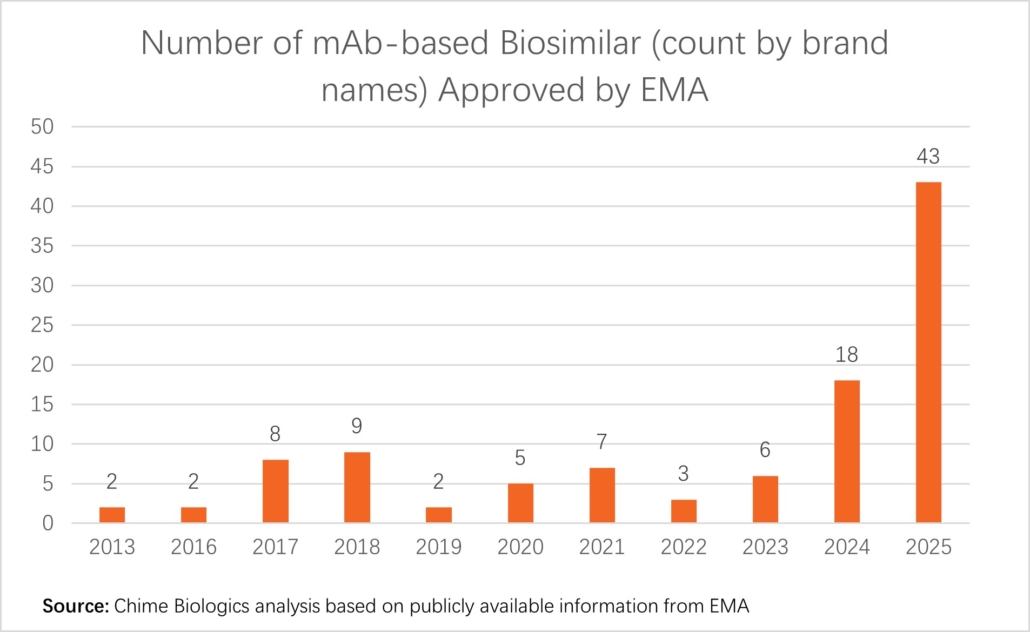
Figure 1
The first insight is straightforward:
The number of marketed biosimilars has surged over the past several years, reflecting growing confidence from regulators, physicians, payers, and manufacturers alike.
The second insight is far more interesting.
To understand where biosimilar competition is heading, it is necessary to look beyond approvals and examine who actually owns these products and where they are manufactured. (Figure 2)
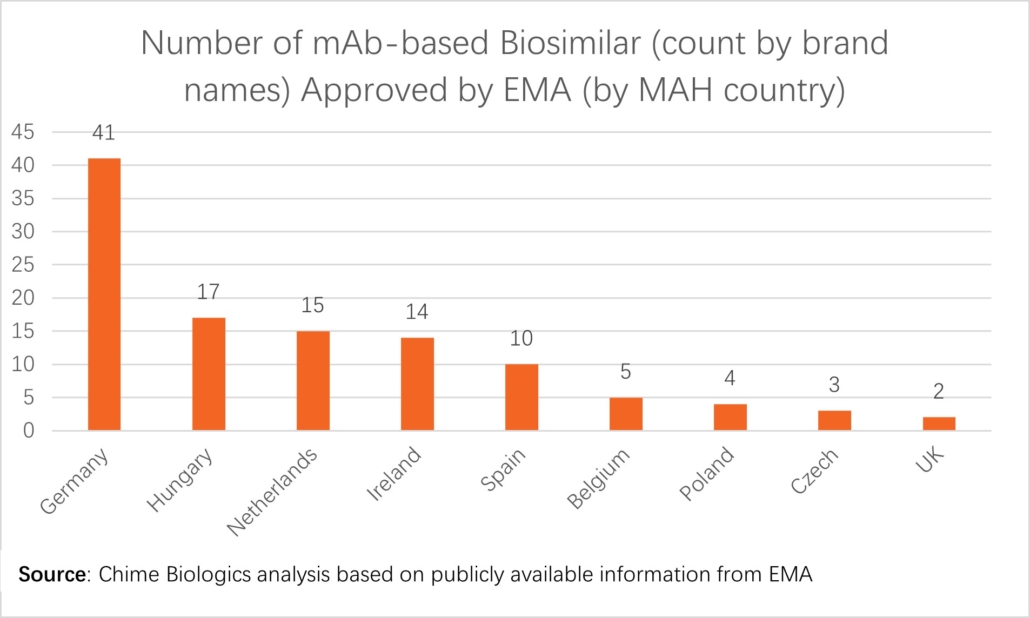
Figure 2
At first glance, the European biosimilar landscape appears highly concentrated.
The vast majority of market authorization holders (MAHs) operate through legal entities located in only a handful of European countries. Even Korean biosimilar leaders such as Celltrion and Samsung Bioepis commercialize their products through European subsidiaries and local organizations in Hungary and the Netherlands.
Viewed solely from the perspective of MAHs, the industry appears dominated by a relatively small group of countries.
However, the picture changes dramatically when drug substance manufacturing locations are mapped. (Figure 3)
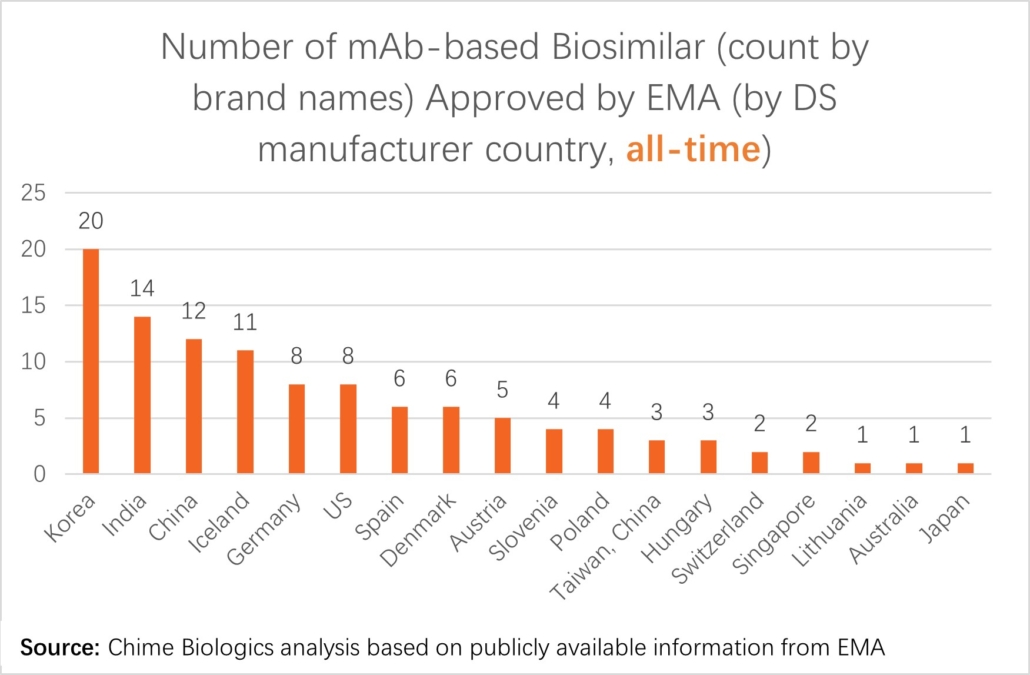
Figure 3
A different group of leaders emerges.
Korea, India, China, and Iceland have become some of the most important manufacturing hubs supporting Europe's biosimilar market.
This distinction is important because manufacturing capability ultimately determines how quickly and efficiently biosimilars can be developed, scaled, and supplied globally.
If we look more closely at the number of approvals over the past three years, these four countries are spearheading the manufacturing of biosimilars in Europe at an accelerating speed comparing to others. (Figure 4)
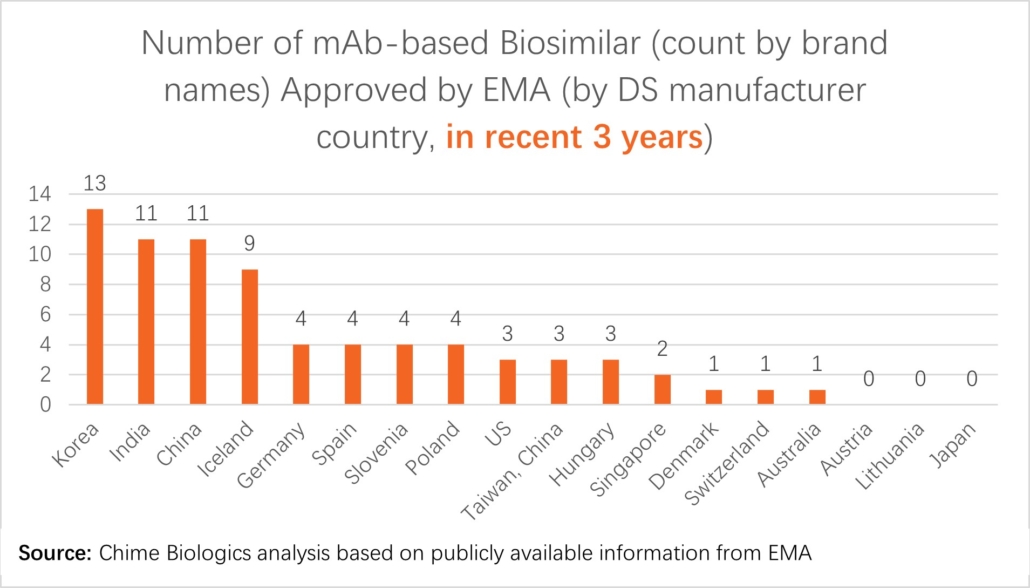
Figure 4
Yet among these manufacturing leaders, China stands apart.
China's Unique Position in the Biosimilar Value Chain
Korea's biosimilar success has largely been driven by vertically integrated champions that developed, manufactured, and commercialized products internally.
A similar pattern can be observed across many biosimilar programs originating from other leading manufacturing countries such as India and Iceland.
China's rise has followed a different path.
In addition to producing its own biosimilar developers and MAHs, China has built something that few other regions have successfully established:
A comprehensive biologics CDMOs with bioprocess and service supply chain ecosystem capable of supporting external developers throughout the entire biosimilar lifecycle.
This distinction is often overlooked.
Many countries have produced successful biosimilar companies. However, far fewer have developed an ecosystem that enables other companies to become successful biosimilar developers.
Today, China has developed an increasingly efficient ecosystem spanning every segment of the biologics value chain capable of supporting biosimilar programs from concept through commercialization.
Like the Chinese industrial ecosystems that helped transform sectors such as consumer electronics, home appliances, and electric vehicles, China's biologics innovation, development and manufacturing ecosystem is creating advantages that extend beyond any individual company as well as other countries.
For companies seeking to enter the biosimilar market, this ecosystem can significantly reduce the barriers traditionally associated with biologics development and manufacturing.
Why This Matters for the Dupilumab Biosimilar of Daewoong Pharmaceutical?
As a newcomer entering one of the most competitive biosimilar races globally, Daewoong Pharmaceutical's challenge is not merely to develop a dupilumab biosimilar, but to do so with the speed, quality, scalability, and cost competitiveness required to compete against established biosimilar leaders.
By strategically partnering with Chime Biologics, Daewoong gains access not only to biosimilar development and manufacturing expertise, but also to a fast-evolving and comprehensive biologics ecosystem that is shaping the future of biologics development and manufacturing.
Through the Chime Innovation Alliance, our partners can leverage cutting-edge technologies from leading Chinese bioprocess and service suppliers that deliver both innovation and efficiency.
Through the Chime AI Platform, rapidly evolving artificial intelligence technologies may be translated into practical applications across biologics CMC development and manufacturing workflows.
Combined with Chime Biologics' experienced biosimilar team and manufacturing network, these capabilities create a differentiated model for biosimilar acceleration.
The Next Biosimilar Winners May Look Different
The conventional view of biosimilar competition focuses on products, companies, and facilities.
Europe's biosimilar market suggests a different reality.
Increasingly, competition is occurring between biologics industrial ecosystems.
The companies that succeed in the next generation of biosimilars may not be those with the largest internal organizations. They may be those that most effectively connect commercial ambition, scientific expertise, development and manufacturing ecosystems across multiple regions.
Daewoong Pharmaceutical's partnership with Chime Biologics reflects this emerging model. More importantly, it offers a glimpse into how future biosimilar challengers may succeed in an increasingly crowded global market.
About Chime Biologics
Chime Biologics is a leading global CDMO, focused on ensuring our customers' success in delivering innovative biologics as well as biosimilars to patients across the world. Chime Biologics can support customers end to end, from pre-clinical support and cell line development through to clinical and commercial manufacturing of drug substance and drug product. Employing our state-of-the-art capabilities in our Europe Innovation Hub (Basel, CH), China Innovation Hub (Shanghai, CN), Development & Manufacturing Campus (Wuhan, CN) and proven success in supporting our clients with their clinical and commercial authorizations across the globe, Chime Biologics is a true end-to-end solution provider for the biologics industry. With over 600 skilled employees, we share a common goal to make cutting-edge biologics affordable and accessible to patients worldwide, fulfilling our commitment to improving human health globally.

