

Inside the partnership between Chime Biologics and Polpharma Biologics International
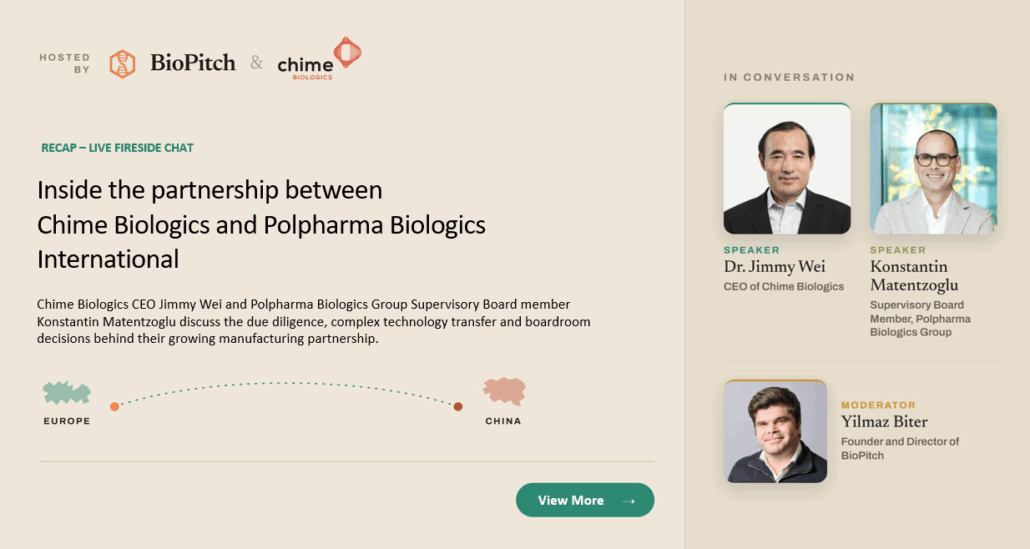
Chime Biologics CEO Jimmy Wei and Polpharma Biologics Group Supervisory Board member Konstantin Matentzoglu discuss the due diligence, complex technology transfer and boardroom decisions behind their growing manufacturing partnership.
When Konstantin Matentzoglu first visited Chime Biologics, he came alone. Jimmy Wei, Chime’s CEO, had met him at the J.P. Morgan Healthcare Conference and invited him to Wuhan. Matentzoglu accepted and made a half-day stop. ‘’Typically, a CEO or senior executive would bring a team’’, Wei recalls. ‘’But Konstantin told me he wanted to come by himself and take a look at the facility. If he was comfortable, he would bring the team. Because if you bring a bigger team to China and the company is not qualified, you waste a lot of resources.’’
That afternoon marked the beginning of a partnership. In April 2025, the two companies announced that Chime would support an undisclosed biosimilar from Polpharma Biologics, now Polpharma Biologics International (PBI), from the IND stage all the way to commercial supply, including manufacturing for a US FDA filing. At first, it was a relatively simple arrangement: Polpharma would outsource the development and manufacturing of one biosimilar to Chime. Since then, the partnership has evolved.
Polpharma Biologics is no newcomer to biosimilars. It has successfully brought them through development and into highly regulated markets, building substantial scientific, development, manufacturing and regulatory expertise in the process. In September 2025, the group separated its Swiss-based biosimilars product business, now operating as Polpharma Biologics International (PBI), from its Polish manufacturing and development operations, which now operate independently as Rezon Bio.
Rezon Bio builds on this established foundation as a biologics CDMO, carrying forward the experienced teams, infrastructure and development and manufacturing expertise built within Polpharma Biologics. Headquartered in Poland, Rezon Bio now supports global customers in their biosimilar and novel biologics programmes from early development through commercial supply in highly regulated markets.
In fact, in June 2026, Chime and Rezon Bio announced a strategic partnership of their own, bringing together complementary capabilities and manufacturing options in Europe and Asia. For programmes where geographic diversification, additional manufacturing capacity and supply-chain resilience are important, the collaboration provides the option to establish a dual-source manufacturing strategy.
Konstantin Matentzoglu, a member of the Polpharma Biologics Group Supervisory Board, used to run a biologics CDMO himself as CEO of Celonic Group. He has seen outsourcing from both sides of the table.
Chime, for its part, has grown into an international CDMO. According to Wei, it employs around 900 people and has more than 36,000 litres of bioreactor capacity (the tanks in which cells produce the medicine) and operations in the US, Europe, South Korea and Japan. ‘’We are now a global CDMO’’, he says. Its European Innovation Hub in Basel opened in June 2025, alongside a China Innovation Hub in Shanghai and its Development and Manufacturing Campus in Wuhan.
On 30 September, BioPitch hosted a live fireside chat with Jimmy Wei and Konstantin Matentzoglu, for an audience of professionals from Europe, China and the United States. They discussed Matentzoglu's visit to Wuhan, the unexpectedly complex technology transfer, the challenge of winning over two separate boards, and how the experience has developed from a single-product collaboration into a broader relationship between Polpharma Biologics Group and Chime.
Why China matters now
By mid-2015, China’s drug regulator was facing a backlog of around 22,000 applications. Ten years later, China-based companies were involved in five of the ten largest research and development (R&D) licensing deals struck between January and October 2025. For a long time, the country’s pharmaceutical industry was mainly associated with generic drugs, active pharmaceutical ingredients and contract research. Then came the national reforms that began in 2015, which cleared the way for innovation. And in June 2017, China joined the International Council for Harmonisation (ICH), bringing its standards closer to those of the FDA and the EMA.
Policy opened the door, but it took people to walk through it. Scientists and executives who had trained and worked abroad, often in the United States, returned to build companies at home. Jimmy Wei is one of them. He studied biology at Wuhan University, earned his PhD in biochemistry at North Carolina State University and worked in the United States for about sixteen years before returning to China. Today, Chime’s main development and manufacturing campus is in the city where he studied.
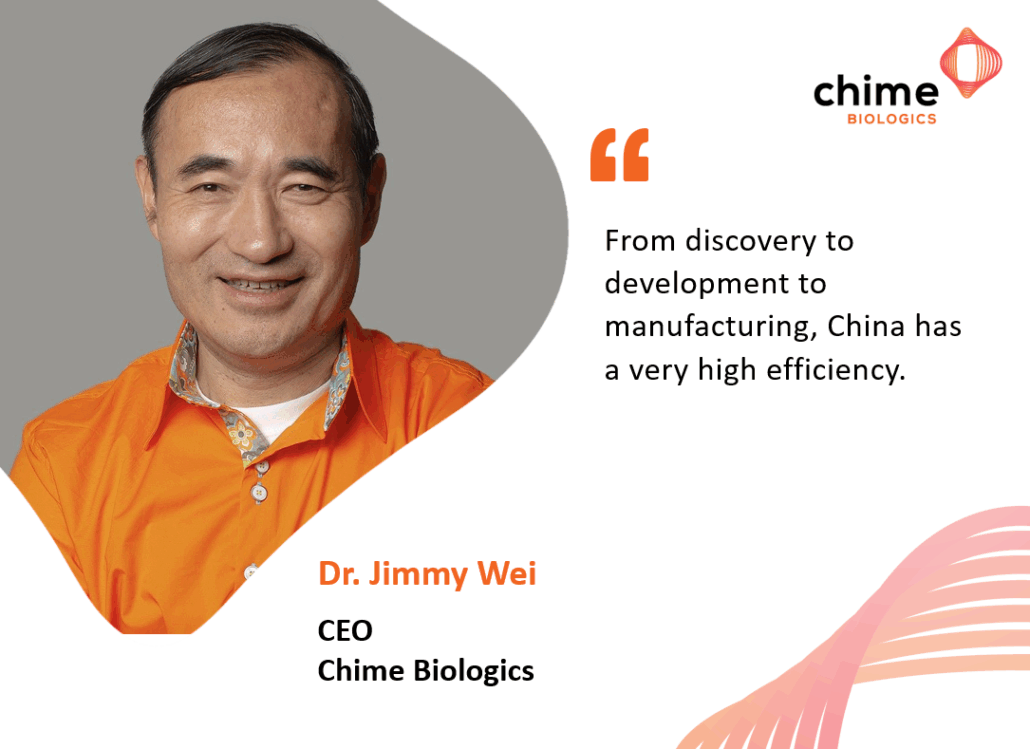
That progress is now visible in dealmaking. DealForma found that 38% of large-cap pharma in-licensing deals with at least $50 million upfront originated in China. ‘’From discovery to development to manufacturing, China has a very high efficiency’’, Wei says. ‘’That’s why more and more companies come to China looking for assets.’’ China's growing pharmaceutical industry has also created opportunities for contract development and manufacturing organisations (CDMOs). ‘’In the past, many Chinese CDMOs were not very global’’, Wei continues. ‘’But over the last few years, companies like Chime have begun to emerge as global CDMOs. That is why China is a very good place if you are looking for a manufacturing partner.’’

Beyond the price
One of Matentzoglu’s reasons for travelling alone was a practical one. ‘’It is about efficiency’’, he says. ‘’If I go there first and I trust what I see, then it is worthwhile to invest the additional money before a larger team travels and spends time on such an evaluation. On a visit like that, you check a couple of hygiene boxes: GMP, the quality mindset, and the quality people. You check the team leading the respective functions, and you take a facility tour.’’ His time running a CDMO taught him what to look for. ‘’If you walk through the facility, you see that there is someone who knows what they’re doing. Language is really not a barrier. Even when you talk to clean room operators, you meet people who speak English very well. And Chime Biologics is, from my perspective, one of very few CDMOs in China that checks these boxes. At the same time, it’s a growing business, which allows you to interact on a different level. That’s why this is really a collaborative development. You rarely see that in the CDMO space. Many CDMOs deal transactionally, at least on a single product.’’
‘’We found a CDMO where we had the trust that they will pass the FDA’’, Matentzoglu says. ‘’For us, that is obviously the most important criterion for CDMO selection, because our products ultimately go into the US market as well. At the same time, I have to say that, for me, China is a lot about cost, very clearly, and that is driven by the efficiency Jimmy mentioned. You can literally get much more output for the dollar than you can get in Europe, not to mention the US, which is even more expensive than Europe. That’s why, for us, as a biosimilars business, cost efficiency at the required quality and output is what you are looking for.’’
On Chime’s side, the deal needed more than the CEO’s conviction. According to Wei, Polpharma Biologics was not well known in China because of its focus on biosimilars. So Wei and his team visited its facilities in Amsterdam and Warsaw to better understand both its biosimilar track record and its development and manufacturing capabilities. At the time, these activities operated together as Polpharma Biologics. Following the 2025 separation, they now operate as distinct businesses under the Polpharma Biologics Group umbrella: the biosimilar product business as PBI, and the development and manufacturing business in Poland as Rezon Bio. ‘’We were extremely impressed by the capabilities of the team, and they already have multiple products approved by the US FDA’’, he says. ‘’We view it as a long-term partnership. We are already seeing results from our first partnership, and of course we are looking forward to many other things still to come.’’
A different speed
What happened once the agreement was signed? ‘’We started with a classical tech transfer approach, transferring the process from Poland to China’’, Matentzoglu says. ‘’And we were met by a Chime team that was operating at a different speed. To be very frank, we had to adjust to it. Initially, it was a bit of a challenge for our team to increase the RPM on our end. And obviously you have the intercultural barrier and all the prejudice you need to get over first.’’ The turning point came when the Polish team travelled to Wuhan. ‘’When the team first visited Wuhan and engaged with the working teams of Chime, all this friction disappeared quite quickly.’’
‘’I put it partly down to the fact that the cultural distance between Poland and China is probably not as big as it is between China and other European countries or the US’’, Matentzoglu says. ‘’There is a similar work attitude, a similar discipline, a similar drive to deliver and achieve. Then we went through the tech transfer very quickly. It was a very difficult and challenging process, but the teams managed to transfer the technology. They are manufacturing now, and we have done the back transfer as well. The teams work together quite nicely.’’
The most challenging step for Chime was one that neither company had full control over: transferring the cell line, the engineered cells that produce the biosimilar, from Poland to China. This required government approval on both sides, and it was uncharted territory for both governments. ‘’This was probably the first time a Polish biologics company collaborated with a Chinese biologics company’’, Wei explains. ‘’The cell line transfer took much longer than we thought, because it has to go through government approval on both sides, and both authorities were not familiar with this. After that, the overall transfer was quite successful and easy. The major reason is that both teams put a lot of resources behind it. All the functions were involved: process, quality, analytical, manufacturing.’’
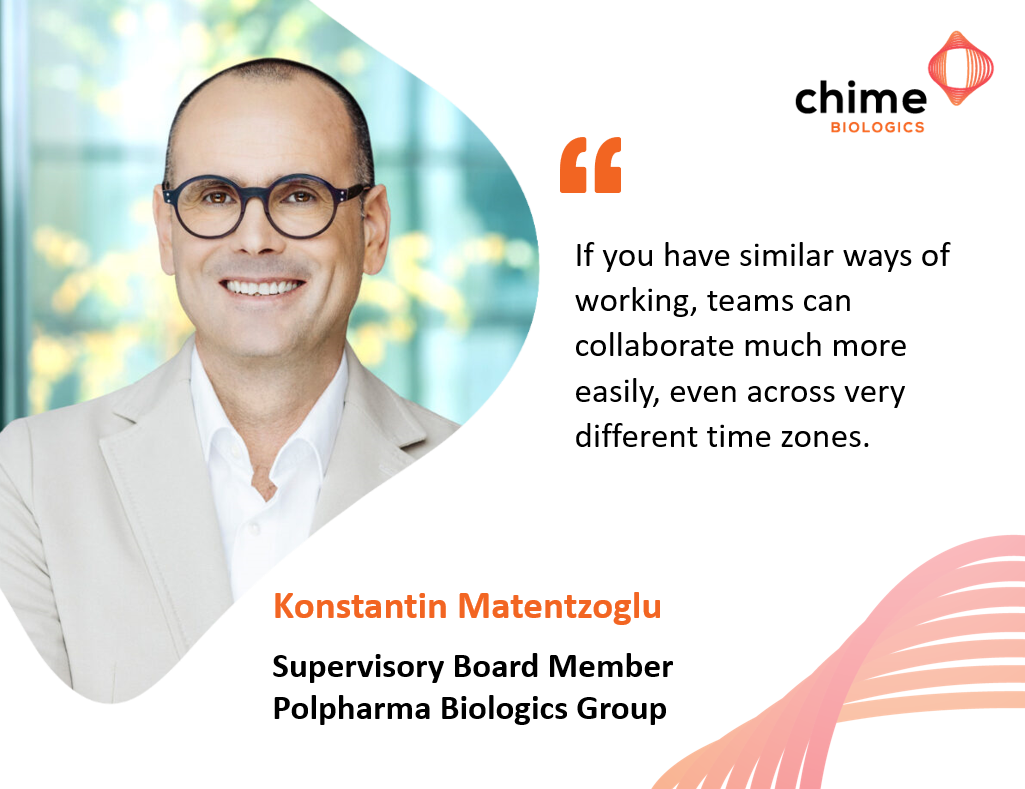
For Matentzoglu, it goes beyond trust. ‘’It’s not necessarily only about trust. It’s about ways of working. If you have similar ways of working, teams can collaborate much more easily, even across very different time zones. If your ways of working are different, your cadence is different, your drumbeat is different, then you need to find common ground first. Here, we could skip that completely. People connected immediately and got to work. It simply happened, and to be frank, we were lucky to identify this partnership opportunity and can now build on it.’’
A deal you have to sell twice
Every dealmaker knows that a transaction has to be sold twice: once across the table, and once at home. Here, both companies had to take the partnership to their own boards.
What did it take to convince the board? For Polpharma, price was not the question. ‘’You don’t need to convince anyone about the cost-effectiveness of going to China’’, Matentzoglu says. ‘’It is more a question of risk: the track record and, predominantly, regulatory approval. Can they do it, and will the FDA accept it? Those are the main questions. From the beginning, we had direct access to Chime’s chairperson. We did not have to question whether the company was financially stable, because that was clear from the beginning. Are we willing to take that risk? Obviously the FDA inspection still has to come. Once the team was convinced, it gave the board a very strong recommendation that this would work. It was relatively easy.’’
Chime also had its own board to convince. ‘’After Konstantin’s visit, I was immediately convinced we should work together. That was a no-brainer’’, Wei says. His board chair, however, came from finance rather than biotech and was unfamiliar with Polpharma Biologics. ‘’So we organised a half-day meeting with our chair and our investors to present who Polpharma Biologics is and why we should take on this project. Later, we also brought our board and investors to Warsaw to meet the senior team of Polpharma Biologics. After that, things became much, much easier. Initially, we needed to do some education with our board members.’’
When asked for practical advice on building trust, Matentzoglu admits that in this case it came naturally. ‘’It did not require a lot of guardrails, guidelines and activities.’’ At management level, the relationship was good from the start. The real breakthrough came when the Polish team visited Wuhan. ‘’It was like cutting a knot’’, he says. His one tip: ‘’Meet as quickly as possible. Don’t spend too much time exchanging emails back and forth and having video calls back and forth. Get to know each other quickly, and simply decide whether you find a level of trust or not. If you don’t find it, move on. But if you find it, you have found a big value.’’
Wei adds that trust has to be built at every level, not only between chief executives. ‘’Our quality team talks to the quality team of Polpharma very frequently. Our project managers talk to each other, our manufacturing people talk to each other. Through these working relationships, you gradually build trust.’’ Visits, he says, are part of almost every project. ‘’Over the last two to three years, we have had more than 40 overseas projects. Almost without exception, global companies come to Wuhan to meet us before they commit. And more than 80% of the global customers who come to Wuhan stay with us. For a small biotech, this is often their only project, so they have to be able to find a partner they trust.’’
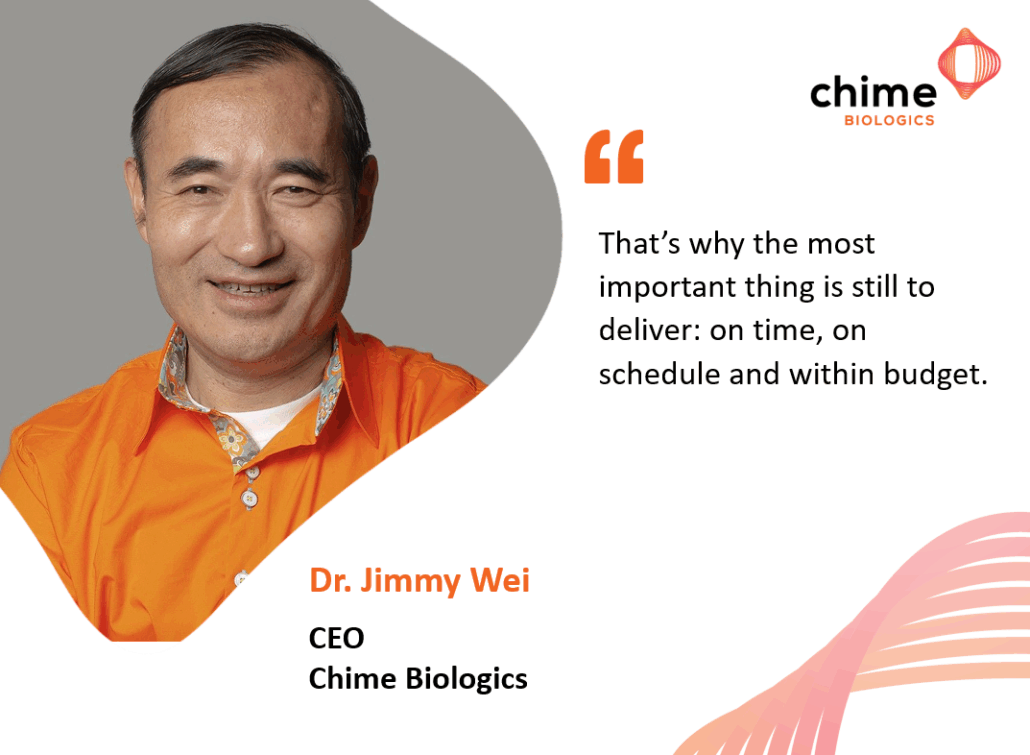
Relationships, however, only go so far. ‘’No matter how good the relationship is, if you get the project wrong, it’s hard to keep it’’, Wei says. ‘’Biologics development and manufacturing is very complex. There are all kinds of ways a project can go wrong. That’s why the most important thing is still to deliver: on time, on schedule and within budget.’’
Thinking and acting globally
When PBI files its biosimilar for approval, the application will include two manufacturing sites, Chime in China and Rezon Bio in Poland. The model builds on the successful technology transfer between the two organisations, establishing manufacturing capability across both geographies. ‘’We transferred the process to Chime. Chime established it and is validating it now’’, Matentzoglu explains. ‘’Then we did a back transfer to Rezon Bio, so I now have a true dual source for the product, and we will file with two manufacturing sites in the licence application. Yes, it comes at a cost, but it has massive economic opportunity while fully de-risking the challenges.’’
An audience question went to the heart of every cross-border manufacturing deal: how do you assess regulatory risk? Wei sees it in layers. ‘’One is, of course, whether Chime can get through a US FDA inspection’’, he says. ‘’With the activities ongoing within Chime, we have very high confidence that we can make that happen.’’ He points to a wider trend as well. ‘’In the last couple of years, more and more facilities in China, especially biologics facilities, have been certified by the US FDA (the FDA inspects pharmaceutical manufacturing facilities for compliance with Good Manufacturing Practice standards, ed.).’’ The second layer lies outside any single company’s control, such as tariffs and the regulatory treatment of products made in China. For Wei, the answer is structural rather than political. ‘’This we can solve with what we call a dual-sourcing partnership. So I do believe there are certain risks, but if we work together, we can address all of those issues.’’
‘’Especially later-stage commercial customers all want global supply’’, Wei says. ‘’We can supply them for China and some other markets, but they also want a partner that is able to provide global dual sourcing. We would like to move towards a stronger partnership, so that together we can provide this to truly global customers.’’ To keep up with demand, Chime is also adding capacity. ‘’Our business is growing very rapidly, so we have to build more capacity. We are building probably one of the largest single-use drug substance manufacturing facilities in the world, which will start at the beginning of next year. We’re also building a high-speed drug product facility and a new R&D facility.’’
What comes next
For Matentzoglu, the outlook for biosimilars is clear. Over the next decade, a large share of today’s biologics will lose patent protection. ‘’Very clearly, every healthcare system, from an economic standpoint, will need to rely heavily on biosimilars’’, he says. Yet according to IQVIA, around 90% of biologics expected to lose patent protection in the US between 2025 and 2034 had no biosimilar in development as of June 2024. For Matentzoglu, the economics remain a major obstacle. Current reimbursement conditions, particularly in Europe and the United States, can make biosimilar development commercially unattractive.
For him, the case is ultimately about access. ‘’For the majority of people to have access to the right medicines, you need off-patent drugs’’, he says. ‘’Otherwise you cannot treat patients; you can only treat the rich and the super well insured. But 80% of this planet does not fall into that category. They need generics, they need biosimilars. That’s why, for me, biosimilars remain a no-brainer.’’ What still has to change, in his view, is policy: reimbursement needs to improve to make biosimilars more economically feasible.
Asked what they had learned from the partnership, neither speaker pointed to a mistake. Wei’s only regret is timing. ‘’I think we should have started working together even earlier, before Polpharma built such a large facility’’, he says. ‘’I wish we could have started this journey earlier. That would have been good for both sides.’’ Matentzoglu’s lesson takes the story back to where it began: a half-day visit to Wuhan, alone. His advice to any biotech leader considering a manufacturing partner in China: do the same. ‘’Go there and see for yourself as quickly as possible’’, he says. ‘’And really at senior leadership level, to get first-hand experience. I think that’s unbeatable.’’
About Chime Biologics
Chime Biologics is a leading global CDMO, focused on ensuring our customers' success in delivering innovative biologics as well as biosimilars to patients across the world. Chime Biologics can support customers end to end, from pre-clinical support and cell line development through to clinical and commercial manufacturing of drug substance and drug product. Employing our state-of-the-art capabilities in our Europe Innovation Hub (Basel, CH), China Innovation Hub (Shanghai, CN), Development & Manufacturing Campus (Wuhan, CN) and proven success in supporting our clients with their clinical and commercial authorizations across the globe, Chime Biologics is a true end-to-end solution provider for the biologics industry. With over 600 skilled employees, we share a common goal to make cutting-edge biologics affordable and accessible to patients worldwide, fulfilling our commitment to improving human health globally.
